

Preamble
OK, usual warning here. I’m no expert and these are my notes as I explore the method suggested by Pat Martino in his book Linear Expressions. The information will be accurate to the best of my ability, but as usual do your own research and buy the book! It’s only 64 pages long.
Introduction
In his book Linear Expressions, Pat Martino put forward a method to help musicians improvise over changes by simplifying the learning and memorisation process while at the same time make it easier to find “jazzy” lines.
Traditionally musicians are required to memorise which scales/modes should be played over the various chord types, a task that quickly becomes burdensome. There are lots of possible scales and modes and lots of chord types, so it’s a real task to commit all of that to memory and the act of recall detracts from the process of making music. Martino’s method helps free the musician to focus on improvisation, not memorisation.
TL;DR
How does the method work? Take any chord you want to play over, reduce or substitute to a minor form, play minor type melodic ideas over the reduced/substituted forms.
In Martino’s Own Words
Pat Martino makes the following statements in Linear Expressions:
“…this system utilizes the minor chord and minor line form only. To further explain, all chords whether they be major, minor, dominant, augmented, diminished, or half diminished quality, can either directly or indirectly be reduced to or substituted by a minor chord form…
Once this is achieved, the player need only play minor type melodic ideas over the minor reductions and substitutions. In other words, convert to minor.” [1]
Like the man says, “convert to minor.” I have also heard “minor everywhere” or even “Dorian everywhere” to describe the method. That’s an oversimplification, but you get the idea.
But beyond simplicity there is an underlying harmonic premise to the approach: he seems to view the ‘hidden’ minor chords as the source of motion and chromatic activity.
To convert any chord into a minor form, he identifies the minor triad/seventh chord hidden within the target chord’s harmonic series – which has the side effect of targeting upper extensions – and exploits the parent dominant-to-minor (V -> ii) relationship.
The Method
A quick glossary of some concepts used by the method:
- Chord Inversions – 4 different inversions of a basic minor 7th chord. Gives us a map along the neck, a bit like CAGED. Also called “Horizontal Movement”.
- Activities – Also called “line forms”. Melodic sequences based on the minor scale. Related to the chord inversions, and used as building blocks for improvisation. These line forms also use passing notes – notes outside the scale.
The method is split into 4 phases, which are described in the following sections.
Phase I: Horizontal Movement
In the first phase you are introduced to the 4 chord inversions and the 5 activities, in one key.
Chord Inversions
The method is based on the idea that any chord (major, minor, diminished, whatever…) can be reduced to or substituted by a minor form.
Therefore, it makes sense to start by understanding a basic minor chord form and its inversions.
To that end, Martino introduces 4 minor chord shapes, with fingerings using the 6th, 4th, 3rd and 2nd strings only.[2] That’s one inversion for each of the chord tones: root, b3, 5 and b7. This is jazz, so including the 7th is obvious!
He chooses Gm7 for his example; a good choice because we can fit all the inversions on a single fretboard in order, starting at the 3rd fret.
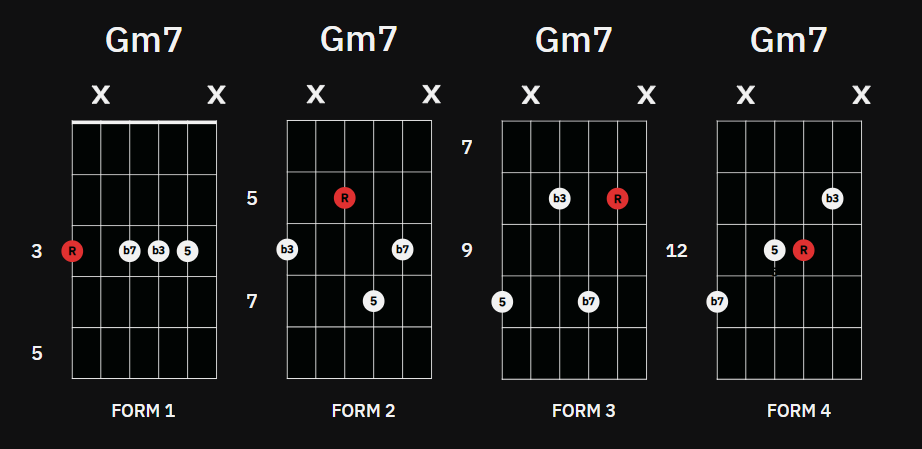
So, four chord forms. That’s it. But don’t forget, you’re expected to figure out the same inversions for 12 possible scales.
Activities
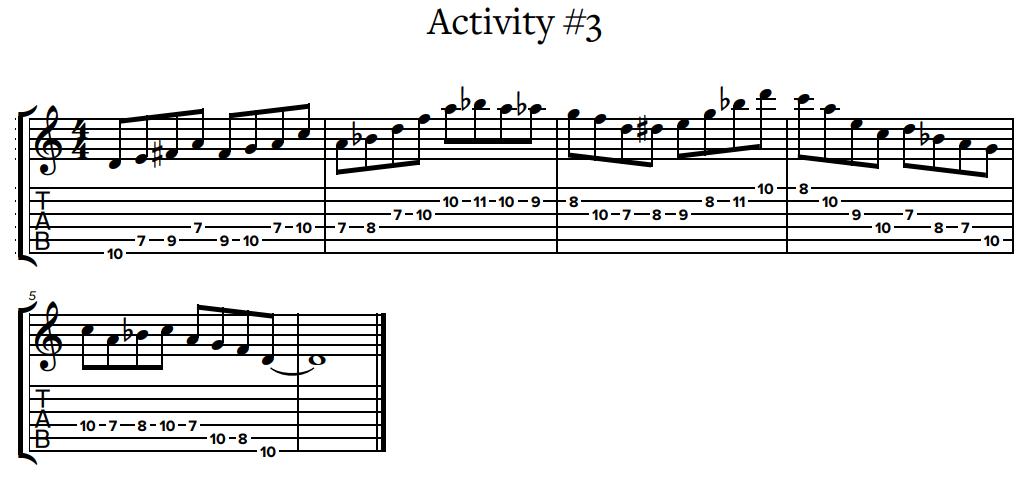
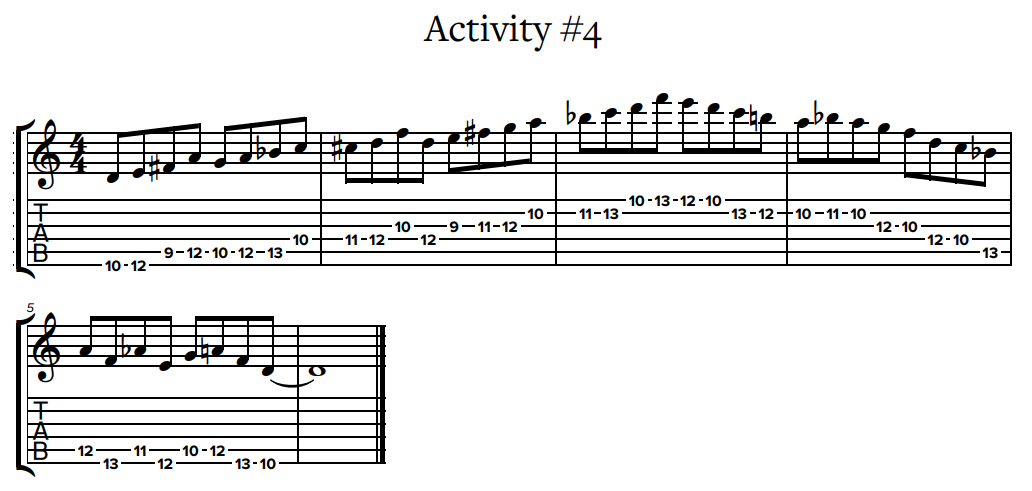
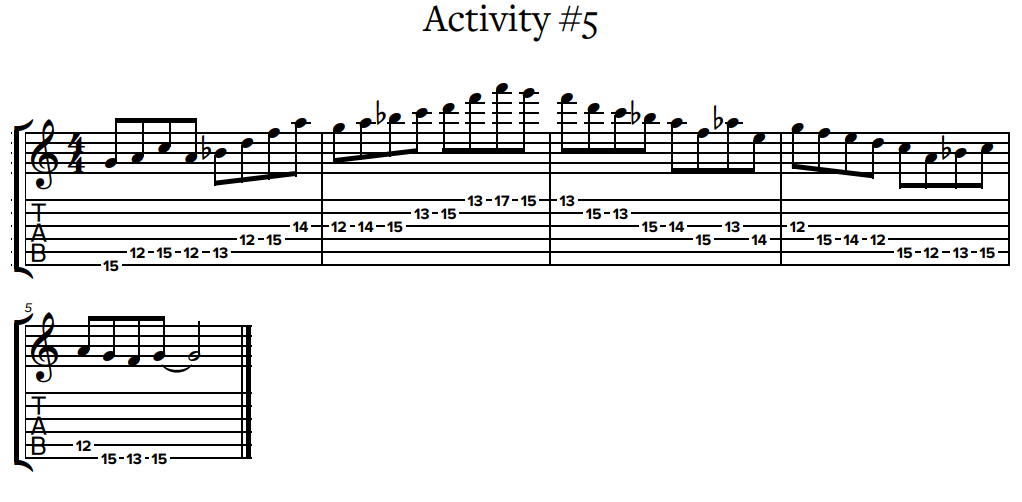
Activities – or line forms – are melodic sequences of notes based on the minor scale. Call them licks, riffs, sequences, whatever. The point is there are 5 of them – one for each of 4 minor chord inversions, plus one extra which is really for the first inversion repeated an octave up.
You are expected to drill them, thoroughly memorise and understand them. Get them under your fingers. They are a fundamental building block for applying the method.
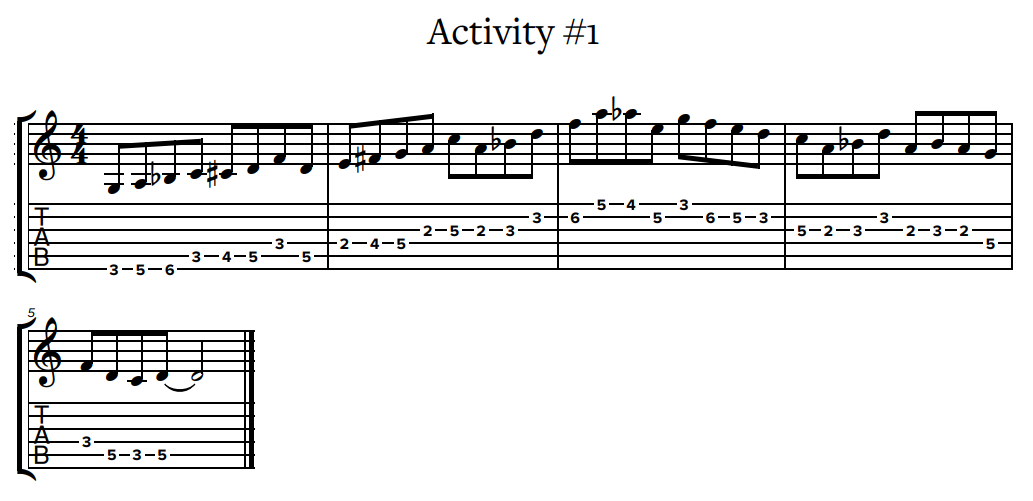
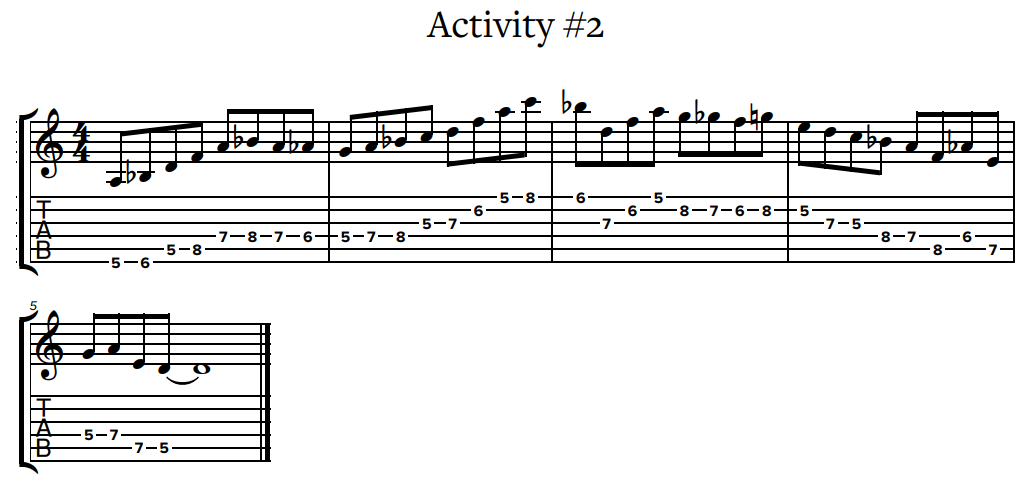
In the book, Martino provides staff notation and a graphical visualisation based on a fretboard diagram for each activity but no tablature, so I have created my own below.
Note also that the graphical notation shows ascending and descending sequences separately. I have seen some commentators treat the ascending and descending parts almost like separate activities to be used independently. Something to look in to.
Activity #1 is to be played over chord inversion 1.
Activity #2 is to be played over chord inversion 2.
Activity #3 is to be played over chord inversion 3.
Activity #4 is to be played over chord inversion 4.
Activity #5 is the odd one out. It’s to be played over chord inversion 1 but nan octave up.
Phase 1 Practise
- Play a chord inversion.
- Play the appropriate activity.
- Repeat steps 1 and 2 for different keys.
What Next?
That’s it for Part I. We’ve covered the first phase of practice and there are 3 more to go. So in the next part we’ll move on to Phase II: Vertical Movement.
References
[1] p.5, Linear Expressions, Pat Martino (ISBN 987-1-4234-6089-3}
[2] p.7, Linear Expressions, Pat Martino (ISBN 987-1-4234-6089-3}