

The Locrian bb3 bb7 scale is the 7th mode of the Double Harmonic Major scale. Because it is derived from a parent scale that contains two distinct augmented seconds, it is highly exotic, unstable, and deeply expressive.
If you are looking for a musical palette that completely steps outside the traditional boundaries of major/minor tension and release, this mode offers an incredibly dense, dark, and almost theatrical harmonic environment.
Scale formula
The formula for the Locrian bb3 bb7 is:
1 – ♭2 – ♭♭3 – 4 – ♭5 – ♭6 – ♭♭7
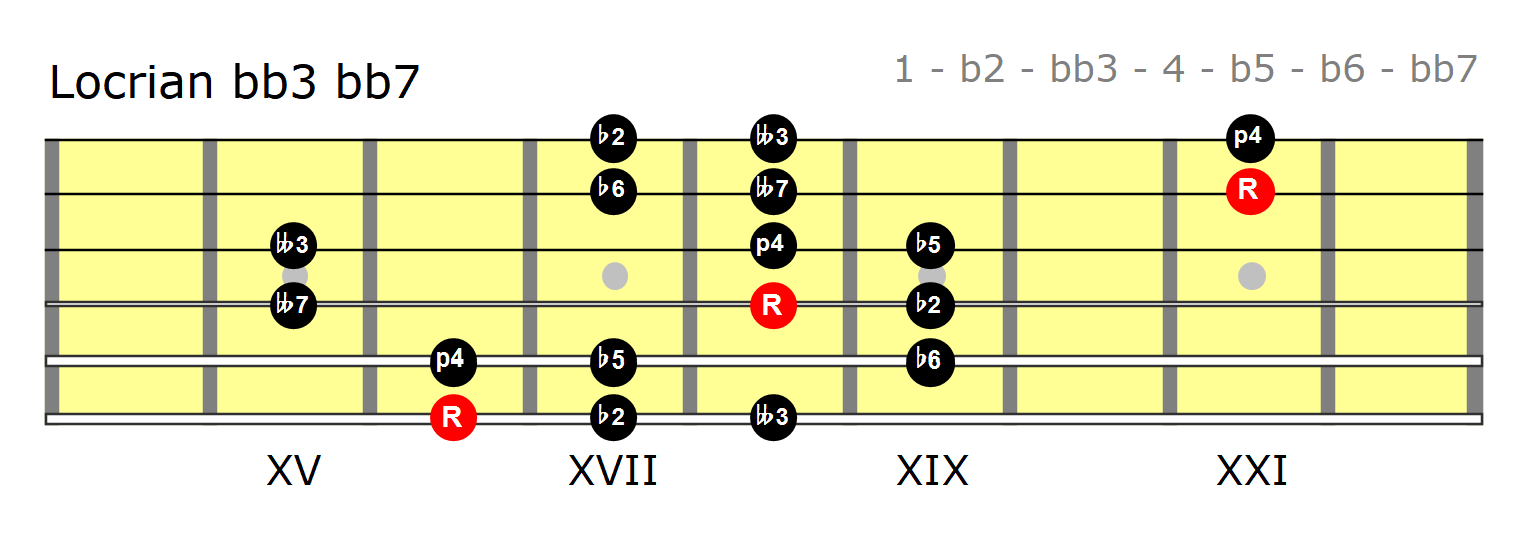
Notes
- The Double-Flatted 3rd (bb3) – This is functionally a major second interval from the root, but structurally it acts as the minor third of the scale.
- The Double-Flatted 7th (bb7) – This is enharmonically equivalent to a major 6th.
Chords
Because the scale contains a root, a double-flatted 3rd (enharmonically a major 2nd), a diminished 5th, and a double-flatted 7th (enharmonically a major 6th), building standard triads out of it yields strange results.
However, when applying this scale over an accompaniment, it functions beautifully as a colour generator over specific modal and altered chords:
-
Diminished 7th / Fully Diminished Contexts (dim7) – Because the bb7 is enharmonically a major 6th, this scale maps perfectly onto the grid of a fully diminished seventh chord (1 – b3 – b5 – bb7). It provides a much more jagged, exotic alternative to the standard whole-half diminished scale.
-
Altered Dominant Clashes (Dom7alt) – You can use this scale to imply an intensely altered dominant texture. Over a Dom7, the b2 acts as the b9, the bb3 acts as a sharp 9, and the b5 acts as the #11.
-
Minor add9(b5) or m6(b5) – If a rhythm section is holding down a static, unresolved minor chord with a dropped fifth and a prominent natural 6th, this scale provides the exact intervallic colouring needed to lean into that suspension.
Usage
This scale offers a brittle, highly tense, and fragmented tonal palette. It completely lacks the anchoring stability of a perfect fifth, and the immediate clashing of the root with the b2 and bb3 creates a tight cluster of micro-tensions.
What it evokes: It sounds ancient, deeply melancholic, and intensely cinematic. It carries a heavy, brooding quality that feels both apocalyptic and ritualistic. Because the intervals shift rapidly between half-steps and wide minor-third gaps, melodies constructed from it sound angular, unpredictable, and labyrinthine.
Musical Settings: It is right at home in modern cinematic scoring (think dark sci-fi, psychological thrillers, or ancient/dystopian settings). It also translates exceptionally well into modern progressive metal and extreme styles where the goal is maximum dissonance without losing a sense of deliberate, sophisticated composition. In a modern avant-garde jazz context, it serves as a highly specialized tool for playing over extreme alterations.
Application Tip
To make this scale speak musically rather than just sounding like random notes, focus on the triad pairs hidden within the parent scale (Double Harmonic Major). For instance, alternating melodies between a clean major triad off the b2 (b2 – 4 – b6) and bb3 (bb3 – b5 – bb7) while the bass anchors on the root (1) will instantly reveal the full, dramatic character of the Locrian bb3 bb7 mode.