

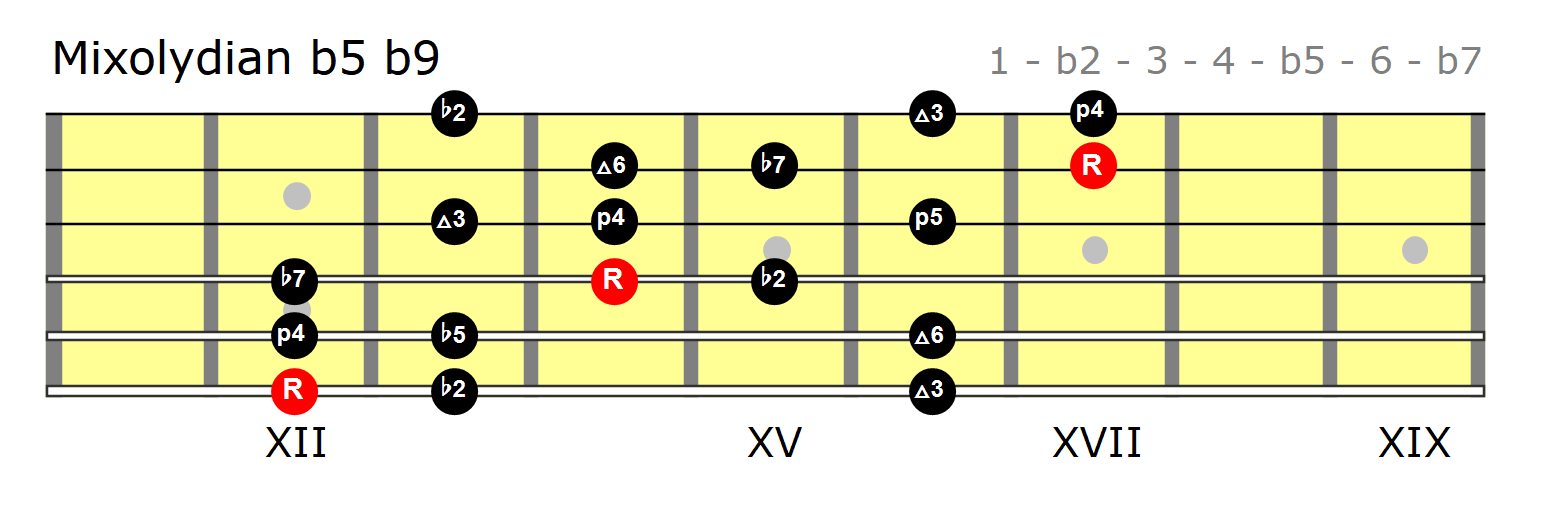
The Mixolydian b5 b9 scale (sometimes historically or colloquially referred to as the Oriental scale) is another fascinating mode of the Double Harmonic Major family. Specifically, it is the 5th mode. This is one of the most vividly “exotic-sounding” modes in existence. It has a deeply hypnotic, heat-haze, and luxurious character.
Scale formula
The formula for the Mixolydian ♭5 ♭9 is:
1 – ♭2 – 3 – 4 – ♭5 – 6 – ♭7
Chords
Because it contains a Root, 3rd, b5, and b7, it outlines a very specific dominant chassis. It is the ultimate tool for improvising over highly altered dominant chords.
You can play Mixolydian b5 b9 over:
-
Dominant 7th Flat-Five – The addition of the b9 and natural 13 creates a deeply colourful Dom13(b5, b9) chord.
-
Altered Dominant Chords resolving to minor – Because of the b9 and the b5 (which can function as an altered #11), this scale acts as a spectacular “V” chord scale in a minor ii-V-i progression.
-
The Major-to-Minor Clashing Lead – Because the scale has a major 6 of the scale and a flat 7, it creates a beautiful push-and-pull between major and minor tonic systems when played over a static major or Dom7 groove.
Usage
-
What it evokes: Mystery, tension, and ancient majesty. It has a distinct Middle Eastern or North African flavour due to the prominent augmented second intervals balanced with major-third dominant stability. It feels dangerous but deeply seductive.
-
Musical Settings: It is incredibly popular in psychedelic rock, desert rock, and heavy metal guitar solos (especially in styles influenced by Eastern scales, like surf rock, thrash metal, or Middle Eastern folk-metal). It is also heavily used in film scoring to paint scenes of vast deserts, spy thrillers, or mystical temples.