
Categorising dominant chords
When it comes to dominant chords we can categorise them in 2 ways:
- Resolving (or functional) dominant 7th chords move to a chord whose root note is a 4th above (or a 5th below). Typically this means we end up on a tonic chord (the I). This is what happens in the ii-V-I progression; the V7 resolves to the I chord.
- Non-resolving (or non-functional) dominant chords have two properties:
- they don’t resolve to a chord up a 4th (or down a 5th), and
- they aren’t preceded by a ii chord.
So, if a dominant chord is followed by a chord with a root a 4th above or 5th below it is a resolving functional dominant. If it doesn’t do that and it’s not preceded by a ii chord then it’s a non-resolving non-functional dominant. However, if a dominant chord does not move to a chord with a root a 4th above or a 5th below but it is preceded by a ii chord we don’t treat it as non-resolving.
So, how can we use this categorisation?
Firstly, when we see resolving (functional) dominant chords we can treat them as having a mixolydian sound and use the mixolydian mode to improvise over them. Simple.
Secondly, if we see a non-resolving (non-functional) dominant chord it is a candidate for being substituted by an altered dominant chord. Possible alterations would be b5, #5, #11, or b13. A very common alteration in this context is the #11. When we improvise over a dominant #11 chord the standard mixolydian mode – which we use over resolving dominants – doesn’t work. What does work is the Lydian Dominant mode.
Just a quick reminder here: a #4, b5 or #11 are really the same note.
What is the Lydian Dominant mode?
Simply put, the Lydian Dominant mode is the 4th mode of the melodic minor scale.
R - 2 - 3 - #4 - 5 - 6 - b7
Actually, the term lydian suggests a #4 (or #11) – that’s what you get in the standard lydian mode – and dominant suggests a b7 like in a dominant 7th chord.
You could think of the scale as being the mixolydian mode with a #4, or as the major scale with a #4 and a b7. To George Russell, inventor of the Lydian Chromatic Concept of Tonal Organization, it’s the lydian scale with a b7 (see the Lydian Flat Seventh Scale in this post).
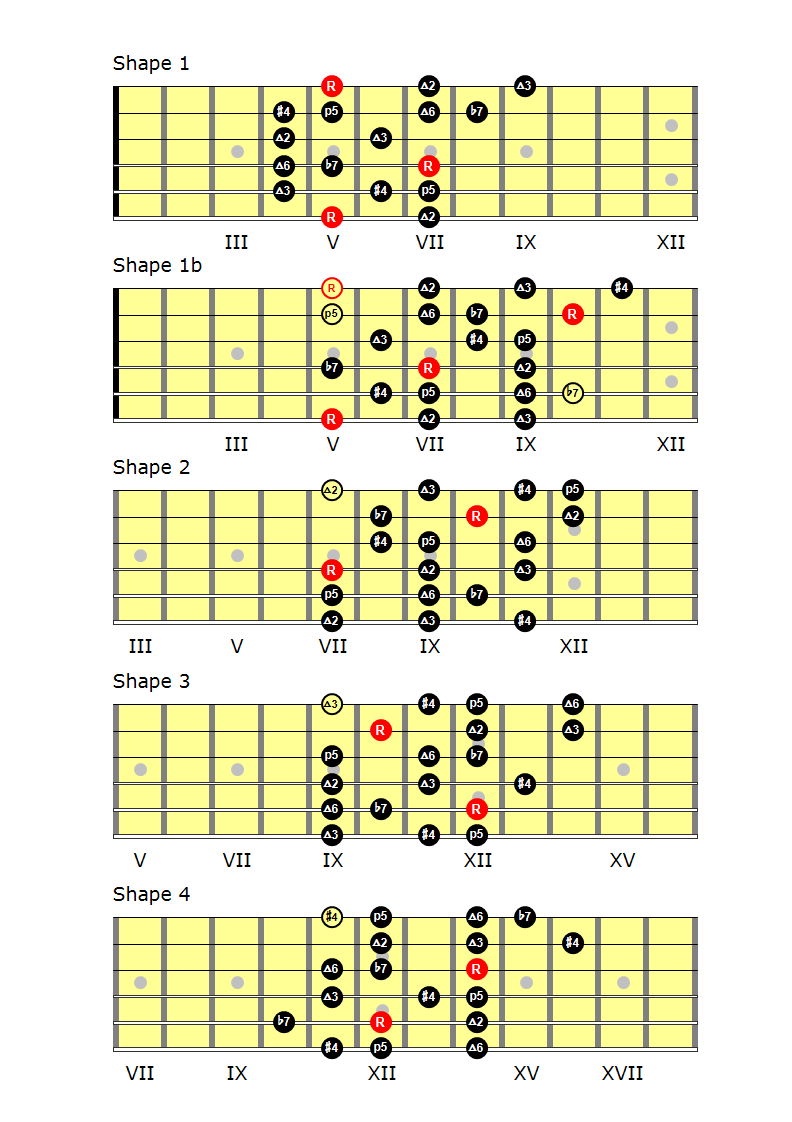
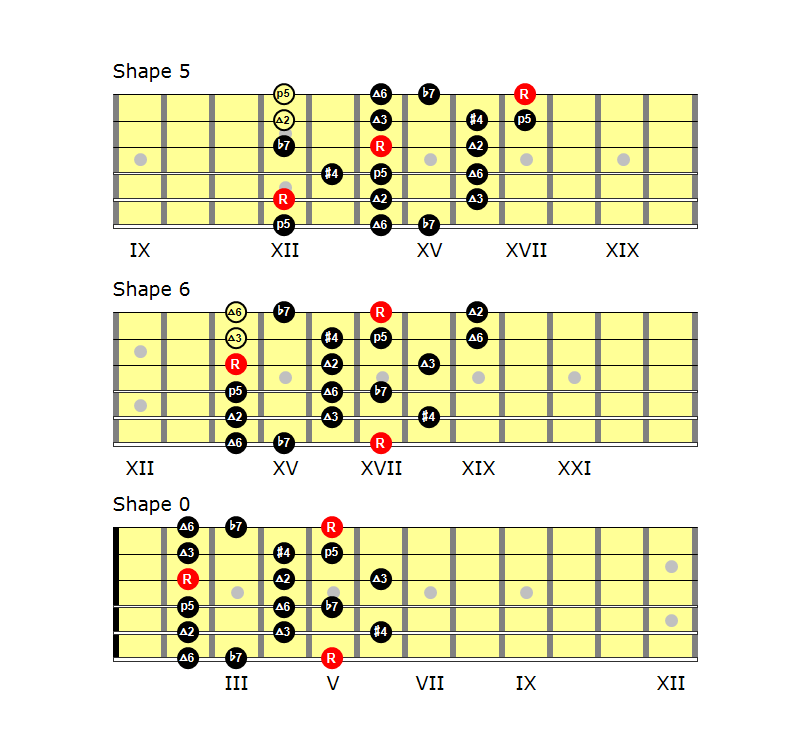
Lydian dominant shapes
Here are some scale shapes for the lydian dominant scale that have been working for me. Remember, the #4 and b7 are what give this scale its flavour.